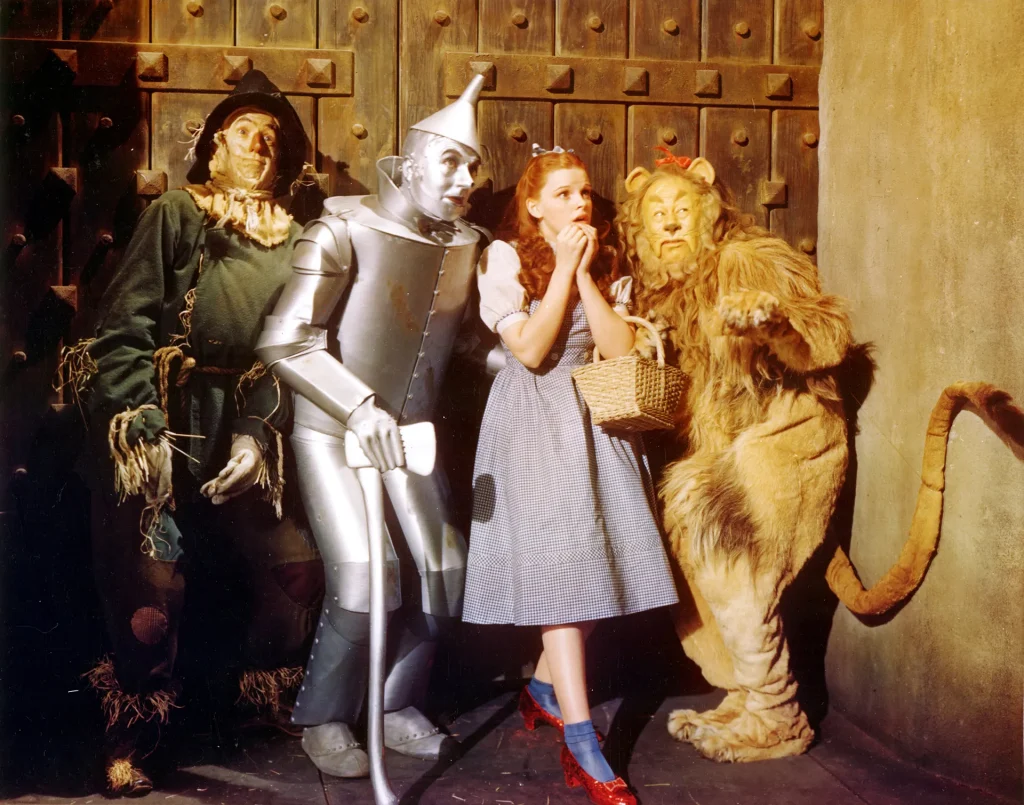

When audiences first watched The Wizard of Oz in 1939, they were whisked away to a vibrant, magical land unlike anything seen before. But while Oz sparkled on screen, the reality behind the scenes was a very different story—one of intense heat, wild innovation, and not-so-magical mishaps. Here’s a look at what the iconic film’s set was really like.
A Technicolor Dream—With a Price
The Wizard of Oz was one of the earliest films to use Technicolor, and that meant the production team had to go big—really big. Everything was designed to be over-the-top so that the colors would read correctly on camera. The Yellow Brick Road, for example, wasn’t just yellow; it was painted in an exaggerated, nearly neon hue to make it pop.
But those brilliant colors came with a downside. The Technicolor cameras required extremely bright lighting, which turned the sound stages into ovens. Temperatures often soared over 100°F (38°C), making filming grueling for cast and crew alike.
Movie Magic Meets Real Danger
The fantasy of Oz was created entirely on sound stages at MGM Studios in Culver City, California. Without CGI or digital effects, the team relied on elaborate practical sets, painted backdrops, and clever in-camera tricks to bring everything to life.
But the magic came at a cost. The Tin Man’s original actor, Buddy Ebsen, had to leave the production after inhaling aluminum dust from his makeup, landing him in the hospital. His replacement, Jack Haley, wore a safer (but still toxic) aluminum paste.
Margaret Hamilton, who played the Wicked Witch of the West, suffered second-degree burns when a trapdoor malfunctioned during a pyrotechnic scene. She took weeks to recover. The flying monkeys? They were suspended on piano wires, and several stunt performers were injured when the wires snapped.
Strange Solutions and Hollywood Ingenuity
Not all the behind-the-scenes details were dangerous—some were just plain bizarre. For instance, the “Horse of a Different Color” was actually a real horse dyed with Jell-O powder. The crew had to shoot quickly before the horse could lick the flavoring off.
Even Glinda the Good Witch’s entrance wasn’t quite as graceful as it seemed. Her magical bubble was a giant suspended glass orb that posed a safety risk if handled carelessly.
A Chaotic Masterpiece
Despite all the challenges, The Wizard of Oz became one of the most beloved films of all time. Its sets, although physically demanding and sometimes dangerous, were groundbreaking for the era. The world of Oz may have looked whimsical and effortless on screen, but it was built on the backs of incredibly hard work, creativity, and more than a little chaos.
It’s a classic case of Hollywood illusion—what we see is magic, but what the cast and crew lived through was very real.