
In Philadelphia, baseball is more than a pastime—it’s a rite of passage. For generations, families have gathered at Citizens Bank Park, hoping to catch a foul ball and create a memory that lasts a lifetime. But on a humid summer night, a single ball sparked a controversy that would shake the city—and the nation—to its core.
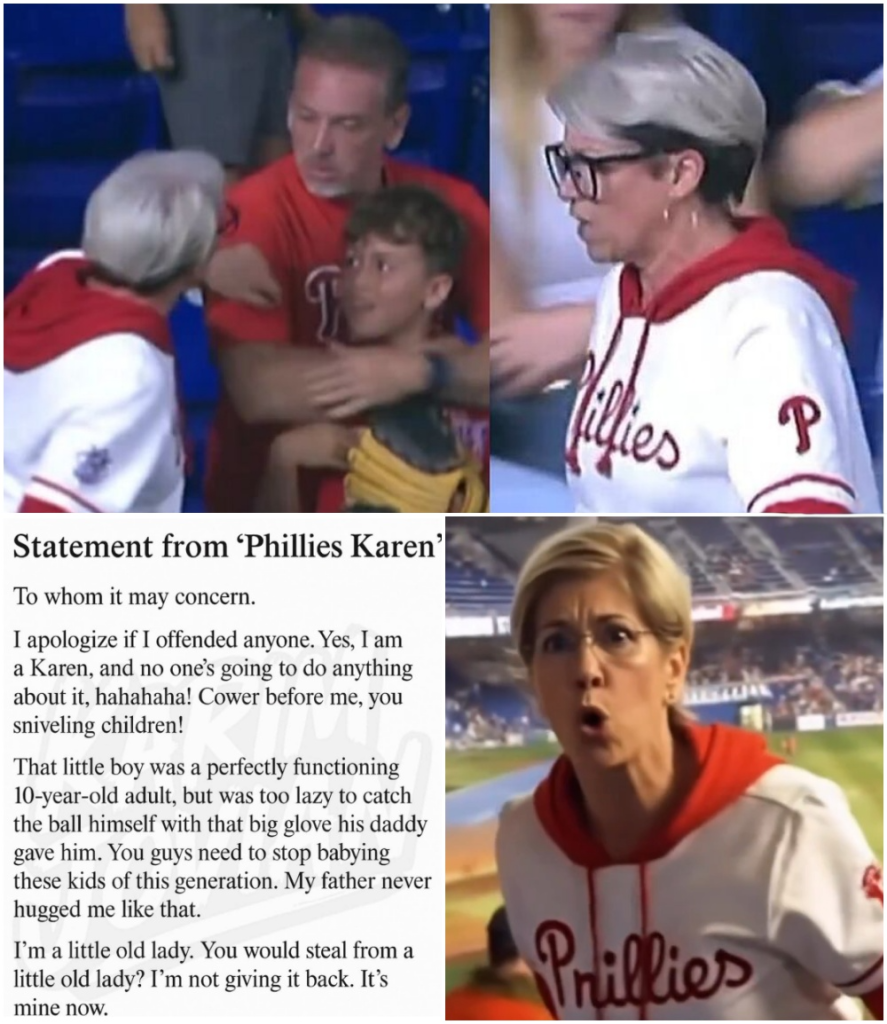
At the center of the storm: Karin Tovia, a fan who snatched a souvenir from the hands of a 10-year-old boy, then became a viral sensation as “Phillies Karen.” Now, after weeks of public outrage, Tovia has broken her silence with an apology that’s anything but forgiving. In a move that stunned the audience, she criticized the boy, refused to return the ball, and demanded to be known by her real name.
This is the story of a moment that became a movement, a fan who became a symbol, and a city forced to confront the dark side of its sporting spirit.
The Incident: A Souvenir Turns Sour
It started innocently enough. Drew Feltwell, a lifelong Phillies supporter, brought his son Lincoln to the ballpark for a night of father-son bonding. When a foul ball ricocheted into the stands, Drew caught it and handed it to Lincoln—a dream come true for any young fan.
But the dream quickly turned into a nightmare. Karin Tovia, seated nearby, reached over and snatched the ball from Lincoln’s hands. The crowd gasped. Lincoln froze, his joy replaced by confusion and heartbreak. Drew was stunned, unable to process what had just happened.
Within minutes, the moment was captured on smartphones and shared across social media. The hashtag #PhilliesKaren trended nationwide. Memes multiplied. Tovia’s face became the emblem of entitlement, her actions dissected by pundits and fans alike.
The Fallout: Viral Fame and Public Outrage
As the video spread, so did the outrage. Sports radio hosts condemned Tovia’s behavior. Fans called for her banishment from the ballpark. Lincoln received an outpouring of support—gifts, tickets, and messages from strangers who wanted to restore his faith in the game.
The Phillies organization responded swiftly, inviting Lincoln back for a ceremonial first pitch and showering him with memorabilia. Sponsors offered trips, signed balls, and VIP experiences. For a brief moment, the city rallied around the Feltwell family, turning a painful incident into a celebration of community.
But the story was far from over.
Karin Tovia Speaks: The Apology That Shocked the City
After weeks of silence, Karin Tovia finally emerged from the shadows. At a hastily arranged press conference, she stood before a packed auditorium—local reporters, national networks, and a sea of Phillies fans eager for answers.
“I want to apologize to the audience,” Tovia began, her voice steady but cold. “I know emotions ran high. I understand people were hurt.”
The crowd leaned in, expecting remorse, perhaps even a gesture of reconciliation. Instead, Tovia delivered a statement that would ignite a new wave of controversy.
“But let’s be honest,” she continued, her tone sharpening. “That boy wasn’t exactly an angel. He pushed, he grabbed, he made a scene. I will not give the ball back. It’s mine now. Please don’t call me Phillies Karen anymore. My name is Karin Tovia.”
The room erupted. Some booed, others shouted in disbelief. Social media exploded—#KarinTovia, #BallparkDrama, and #NotAnAngel trending within minutes.
Analysis: The Psychology of Possession and Public Shaming
What drives someone to hold onto a souvenir at the expense of a child’s happiness? Psychologists point to the phenomenon of “possession obsession”—the idea that objects can become symbols of personal achievement, status, or validation.
“Karin Tovia’s refusal to return the ball speaks to a deeper insecurity,” says Dr. Elaine Murphy, a sociologist specializing in sports culture. “For some, the act of acquiring a rare item is tied to self-worth. When challenged, they double down—not out of malice, but out of fear of losing part of their identity.”
But the public shaming that followed Tovia’s actions also raises questions about the ethics of viral justice. In an age where every moment is recorded, shared, and judged, the internet has become both court and executioner.
“Social media amplifies outrage,” Dr. Murphy explains. “It creates a cycle where forgiveness becomes impossible, and redemption is reserved for those who conform to the crowd.”
The Boy at the Center: Lincoln’s Sleepless Nights
Lost in the controversy is the emotional toll on Lincoln Feltwell, the 10-year-old boy whose ballpark dream turned into a public spectacle. His father, Drew, revealed that Lincoln was in a panic all night, unable to sleep, replaying the moment over and over.
“My son kept asking if he’d done something wrong,” Drew said. “He couldn’t understand why someone would take the ball from him. He felt embarrassed, like he’d let everyone down.”
Child psychologists warn that public humiliation can have lasting effects, especially when amplified by viral attention. For Lincoln, the ball was more than a souvenir—it was a symbol of belonging, a tangible connection to his heroes.
“When that was taken away, so was his sense of safety,” Dr. Murphy notes. “It’s a reminder that adults have a responsibility to protect childhood innocence, not exploit it for personal gain.”
The Ethics of Fandom: What Do We Owe the Next Generation?
The “Phillies Karen” saga has sparked a broader debate about the ethics of fandom. In a culture obsessed with milestones, collections, and personal achievement, what responsibility do adults have to the next generation of fans?
“There’s an unwritten code in the stands,” says sports ethicist Dr. Murphy. “When a child catches a ball, you let them have it. It’s about creating lifelong memories, passing on the love of the game.”
Tovia’s actions—and her unapologetic stance—violated that code, turning a communal experience into a contest of wills. The backlash was swift, but the lesson is clear: sportsmanship is about more than winning. It’s about empathy, generosity, and respect for the spirit of the game.
Public Reaction: Sympathy, Outrage, and the Limits of Forgiveness
As Tovia’s statement circulated, the city’s response was mixed. Some fans expressed sympathy, arguing that viral fame can distort reality and push people to the breaking point. Others condemned her refusal to return the ball, insisting that justice must be served.
“I feel bad for her, but you can’t just go around taking things from kids,” said one Phillies fan outside Citizens Bank Park. “She needs to do the right thing.”
Meanwhile, advocacy groups raised concerns about the impact of viral shaming—on both the victim and the accused. “We need to ask ourselves whether the internet is making things worse,” Dr. Murphy cautioned. “Are we pushing people to the edge?”
Redemption or Ruin: Is There a Way Back for Karin Tovia?
For Karin Tovia, the road to redemption is uncertain. Her demand to be called by her real name—rather than the viral moniker “Phillies Karen”—is an attempt to reclaim her identity. But her refusal to return the ball, and her criticism of Lincoln, have only deepened the divide.
Legal experts say Tovia could face civil action if the Feltwell family chooses to pursue it. “There’s a case to be made for emotional distress,” says attorney Lisa McGregor. “But the real damage is to her reputation. In the court of public opinion, she’s already been tried and convicted.”
Can Tovia rebuild her life after such a public fall? Is forgiveness possible in the age of viral shame? Or will she remain a cautionary tale for generations of fans to come?
The Internet as Judge and Jury
One of the most striking aspects of the case is the role of social media in shaping public opinion—and, perhaps, the outcome of the legal process. In the age of viral justice, the internet often acts as judge, jury, and executioner, dispensing punishment long before the courts weigh in.
Legal scholars warn that this dynamic can undermine due process. “Everyone deserves their day in court,” says McGregor. “But when the internet decides someone is guilty, it can be hard for the legal system to remain impartial.”
In Tovia’s case, the court of public opinion has already rendered its verdict. Whether the actual court will follow suit remains to be seen.
A Father’s Reflection: Why Baseball Still Matters
For Drew Feltwell, the ordeal has been a crash course in resilience. He has learned to navigate disappointment, to accept the kindness of strangers, and to find meaning in adversity.
“I tell Lincoln, ‘Life isn’t always fair, but you don’t let it change who you are,’” Drew says. “You keep showing up. You keep cheering. You keep believing.”
The family’s story has inspired other fans to pay it forward—passing balls to children, sharing souvenirs, and remembering that the real treasure is the memory, not the object.
Epilogue: Beyond the Ball
The Karin Tovia saga will fade, as all viral moments do. But for the Feltwell family, the lessons will endure.
In the end, the story is not about a ball, a meme, or a controversy. It is about a father and son, the fragility of innocence, and the enduring power of hope.
Baseball will go on. Lincoln will sleep soundly again. And Drew will keep teaching his children that, in the stands as in life, kindness is the greatest souvenir of all.