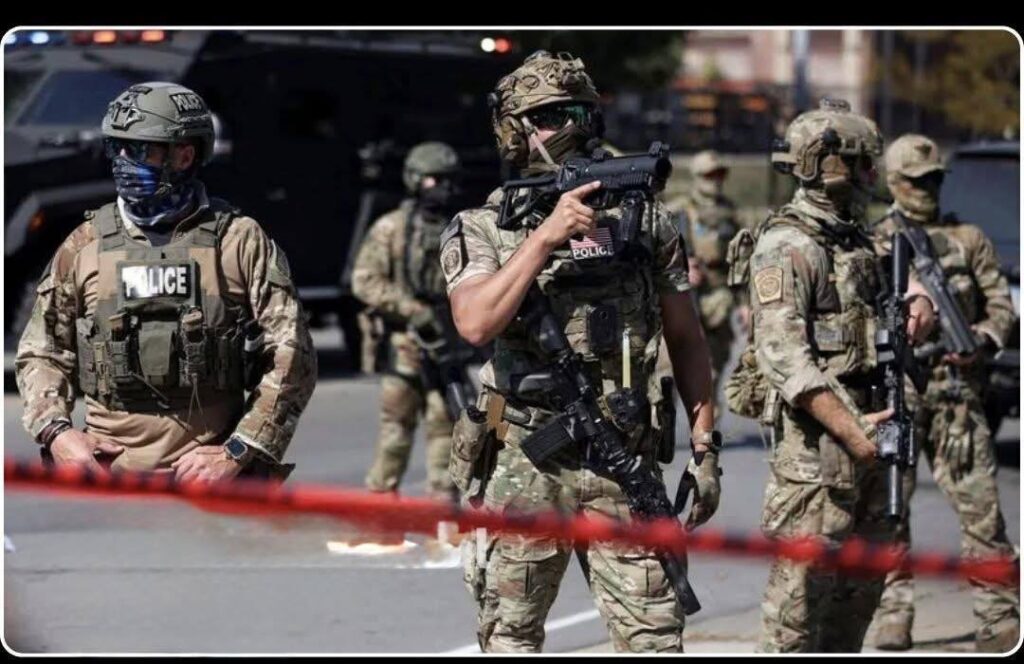

Blood hit the pavement in the early hours of a federal law enforcement operation here before the facts could ever reach the microphones. What followed was a violent confrontation that would immediately ignite a firestorm on social media and dominate cable news cycles, providing a textbook study in the volatility of modern American civic discourse. The incident involved the discharge of firearms by federal agents—a gravity-laden detail that, in almost any other era, would have prompted measured reporting and cautious public commentary from officials. Instead, the response was instantaneous, visceral, and frequently misleading. Within hours of the first report, the narrative had already hardened. Politicians, activists, and journalists moved in lockstep to condemn U.S. Immigration and Customs Enforcement (ICE), accusing the Trump administration of orchestrating “militarized” immigration raids. The federal presence in Portland was painted as an existential threat to civil liberties before investigators could confirm the most basic operational details: who had fired, under what circumstances, and which federal agency was actually on the scene.
The Sanctuary City Flashpoint
Portland, a self-declared sanctuary city, provided the perfect atmospheric conditions for this flashpoint. The city has long prided itself on progressive policies designed to stymie cooperation with federal immigration authorities, rooted in the conviction that local police should play no part in detaining or deporting undocumented residents.
However, this stance creates a highly charged environment where any federal interaction is viewed through a political lens. On the morning of the shooting, early and unverified reports identified the agents as ICE personnel. This misattribution would go on to shape public perception for days, fueled by social media posts labeling the operation a deliberate, militarized raid.
A Case of Mistaken Identity
By the time investigators could determine that the agents involved were actually from U.S. Customs and Border Protection (CBP)—not ICE—the public anger had already reached a crescendo. While both agencies fall under the Department of Homeland Security (DHS), the distinction is more than semantic.
ICE is primarily tasked with identifying and arresting undocumented immigrants already residing within the interior of the U.S. CBP, conversely, focuses on border enforcement and the protection of ports of entry.
Misidentifying the agency didn’t just skew the technical understanding of the event; it fueled a politically charged narrative that bore little resemblance to the operational reality. Yet, Portland’s political leadership joined the chorus of condemnation without hesitation. The mayor invoked the specter of “federal militarization,” threatened legal action, and tied the shooting to national immigration policies—all before the responsible agency was confirmed or an assessment of the threat faced by the agents was completed.
The Speed of Misinformation
Local police, caught in a community that views sanctuary policies as essential, were quick to distance themselves from their federal counterparts. Meanwhile, federal officials urged restraint, calling for a thorough review of body-camera footage, forensic evidence, and operational reports.
By the time these facts were verified, the initial narrative had already taken deep root. This follows a troubling pattern seen in previous incidents, such as the shooting of Winston Smith in Minneapolis, where initial claims were amplified by media and political actors only to be contradicted by video evidence or official investigative findings later.
In Portland, federal officers were cast as villains in a pre-written political script long before the facts were established. This erosion of public trust complicates the objective understanding of law enforcement protocols. CBP agents operate under strict rules of engagement, including rigorous assessments of immediate threats to life and use-of-force protocols.
The Lasting Impression
When these protocols are enacted in visible urban areas, they are often interpreted through a political lens rather than an operational one. For many Portland residents, any show of armed federal authority is perceived as an aggressive encroachment on local autonomy, regardless of the legality or necessity of the action.
The result is a persistent tension between the enforcement of federal law and the maintenance of community trust—a balance made increasingly precarious when media narratives and social media amplification take precedence over investigative verification.
Perhaps most telling is that even after investigators confirmed CBP’s involvement, the correction had little impact on the public discourse. The initial framing of “federal militarization” remained the dominant theme. Cable news panels continued to debate the implications of federal authority in sanctuary cities, and activists organized protests based on the earlier misinformation. In the current climate, it seems, the first impression is the only one that lasts.
The persistence of the initial narrative in the wake of the Portland federal shooting illustrates a sobering psychological phenomenon: in the theater of public opinion, first impressions frequently outweigh subsequent corrections. Once the mechanism of outrage is activated—particularly in emotionally charged environments—newly surfaced facts may be acknowledged by the public record, yet they rarely succeed in altering the core perception that has already taken root.
The long-term implications of this incident extend far beyond a single day of social media frenzy. The misidentification of federal agencies, the premature condemnation by public officials, and the lightning-fast spread of unverified claims highlight a deepening fragility in public trust, affecting both law enforcement and the Fourth Estate.
The Velocity of Modern Misinformation
In an era where the news cycle is compressed into mere minutes and information travels instantly via smartphones, the consequences of hasty conclusions are magnified. Public officials, journalists, and activists now operate under a crushing pressure to respond with immediacy. However, when speed overtakes accuracy, the resulting narratives can inflict lasting damage on both the communities they aim to protect and the agencies tasked with enforcing the law.
The Portland incident cast a harsh light on the inherent tensions between federal authority and local governance. Sanctuary cities were designed to shield immigrant communities by strictly limiting cooperation with federal enforcement, such as restricting local police from assisting U.S. Immigration and Customs Enforcement (ICE) or U.S. Customs and Border Protection (CBP). While these policies seek to foster community trust, they simultaneously create a volatile environment.
In such a landscape, any federal operation is instinctively perceived as an aggressive intrusion. Citizens often assume that armed federal agents are acting outside the bounds of the law, even when an operation is conducted legally and in strict accordance with established protocols. This perception is further weaponized when amplified by political commentary that frames every incident as a deliberate assault on immigrant rights.
The Invisible Safeguards of Federal Protocol
Federal agencies face operational and public relations hurdles that the general public often fails to grasp. CBP, for instance, functions under rigid legal mandates that dictate the precise circumstances under which force may be used. Agents undergo extensive training in threat assessment, de-escalation, and the use of firearms, and are required to meticulously document every encounter through body-camera footage and detailed reports.
Yet, these safeguards remain invisible to a public that has already scrutinized and interpreted a use-of-force incident through the lens of local politics rather than operational necessity. In Portland, this dynamic created a scenario where agents acted in alignment with their training and federal law, yet were framed as the aggressors before any formal investigation had even begun.
[Image: A comparative infographic showing the “Speed of Social Media Narrative” (minutes) vs. “Speed of Official Investigation” (weeks/months).]
The Media Feedback Loop
The modern media environment only amplifies this distortion. There is a fundamental tension between the need for speed and the duty of accuracy. Social media platforms reward the immediate and the inflammatory, favoring posts that provoke strong emotional responses. Traditional outlets, fearing a loss of ratings or relevance, often echo these unverified narratives.
The result is a feedback loop where assumptions are canonized as facts in the public imagination. In the Portland case, once the operation was misattributed to ICE, the narrative hardened so rapidly that official corrections struggled to penetrate the established wall of perception.
Legal Repercussions and Societal Polarization
The incident also birthed complex legal questions. Portland city officials explored civil litigation, questioning if federal agents had breached local ordinances or constitutional protections. While federal law generally grants agencies like CBP the authority to operate within domestic jurisdictions, these actions must exist in a delicate balance with local frameworks and resident rights. Civil rights organizations continue to advocate for transparency, reflecting the ongoing struggle to harmonize federal mandates with community standards.
Ultimately, the event highlighted a deepening polarization in how Americans view enforcement. For some, federal agents represent the bedrock of national security; for others, they represent government overreach. While the facts of the Portland case—CBP acting under lawful authority and responding to an immediate threat—provide a nuanced picture, the public’s divergent perceptions remain.
A Cautionary Tale for the Digital Age
Portland serves as a cautionary tale for policymakers, media organizations, and the public at large. It reinforces the principle that investigation must precede judgment. Outrage, however emotionally compelling, is no substitute for evidence.
Educating the public on agency distinctions and procedural protocols could mitigate future misperceptions. In the end, the truth must not only be discovered; in an age of instantaneous communication, it must be actively disseminated and defended against the initial surge of misinformation. Only through a commitment to verification can we preserve the trust between the government, law enforcement, and the public—even amidst our most politically charged moments.